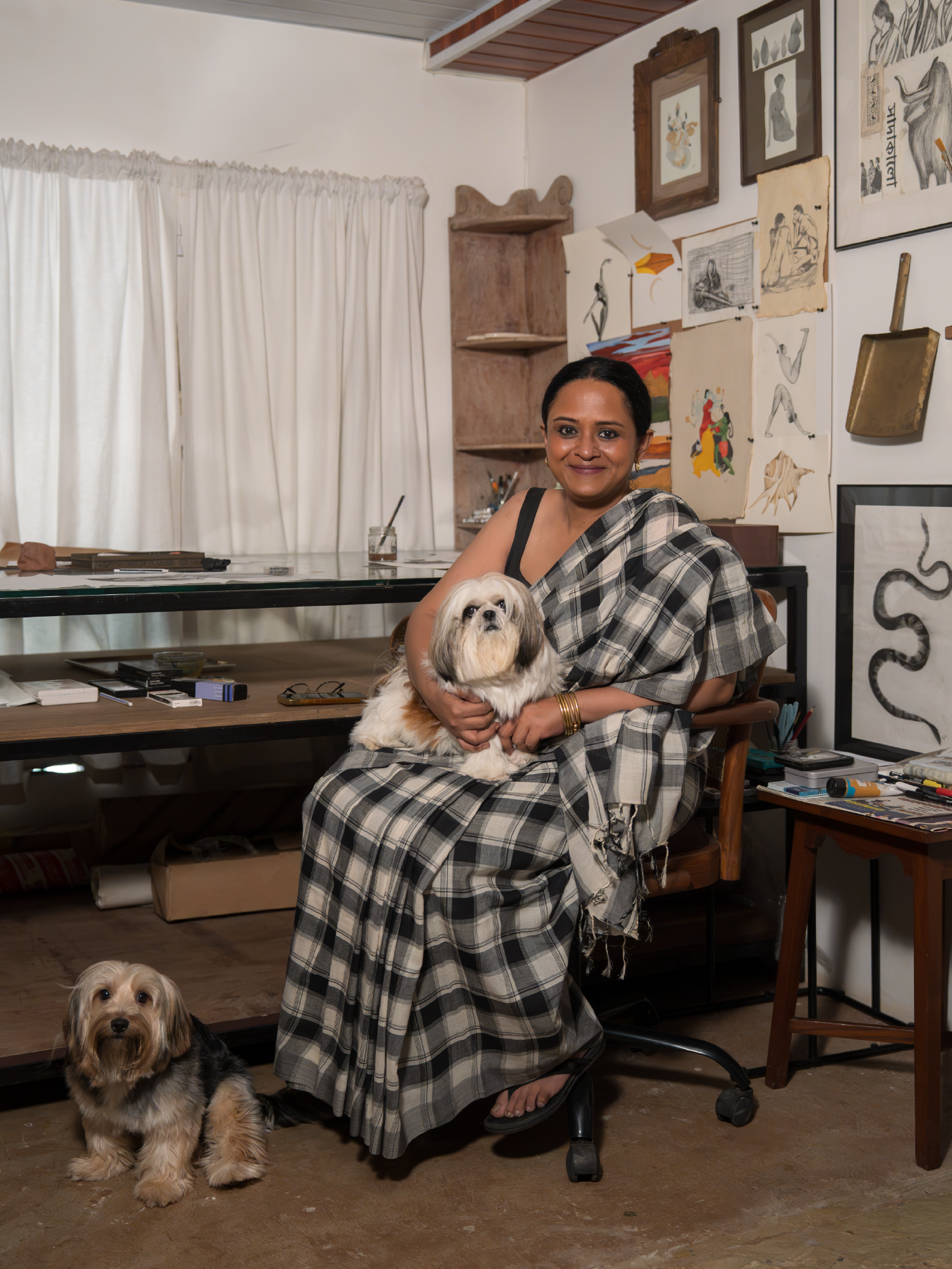
On a warm Thursday morning in October, as I stepped into the bungalow of sculptor and artist Jayati Bose in Mumbai’s Juhu. An adorable Shih Tzu, Circuit and an Australian silky terrier, Toto came running to me, sniffing my toes for any signs of danger. Right behind them Jayati appeared in a black and white cotton checkered saree, unintentionally matching with her dogs.
“All my sarees are simple and cotton,” she says as she pulls a chair settling in her home studio. A work in progress charcoal sketch lies on her raised worktable, and through the window you can peek into her pottery studio where several terracotta sculptures are lined up on shelves and on the floor. The space holds her art — a bust sculpture on the bookshelf, a series of self portraits in watercolours that reflect her post-partum depression and heads in black clay from her discarded series that are scattered across the garden. In every way this is a home of an artist and you can tell. What you can’t tell is that it’s a skill learnt and honed as an adult.
Even though art became a pursuit for her much later in life, the instincts that drew Jayati to it had been developing for a long time. “I was a child who preferred her own company. I could spend hours outdoors,” says the self-taught artist, explaining how being in her own comany often led her to notice things that are easily overlooked, “The way a shadow moves, the personality of an object, the small drama of everyday life. Looking back, I realise that my relationship with nature, solitude, materials and the physical world began long before I understood any of them as artistic concerns. Perhaps the garden was my first studio, although I didn’t know it then,” she says.
Much like how adulthood and routine tends to scrape away at the things that brought us joy as kids, Jayati too took a detour before arriving at art. As a young girl with big dreams, she moved from Asansol in West Bengal to Mumbai and secured an internship with a lifestyle magazine in 2004. She quickly moved through the ranks to lead the fashion and beauty vertical but found herself thoroughly uninterested in writing. A stroke of luck led her to a styling project on the sets of a fashion film from which turned her into a sought-after celebrity stylist for years. The birth of her daughter led to sabbatical from that world but not long after she found her way to art. “It [art] helped me find answers to some things that not even years of therapy could,” she quips, elaborating that art has become a way for her to materialise her thought process, questions she mulls over and concepts that interest her. Though being an artist is what she is truly passionate about now, her previous lives as a journalist and stylist haven’t completely left her. “Journalism fundamentally shaped the way I think. It taught me that the most interesting part of a story may not be what is being said, but what has been left out. Whose voice is missing? What has become so normal that we no longer question it? Fashion made me conscious of the body as something that is never entirely free from social interpretation. It also sharpened my understanding of proportion, textiles, surface, form and composition. My art draws upon both ways of looking.”
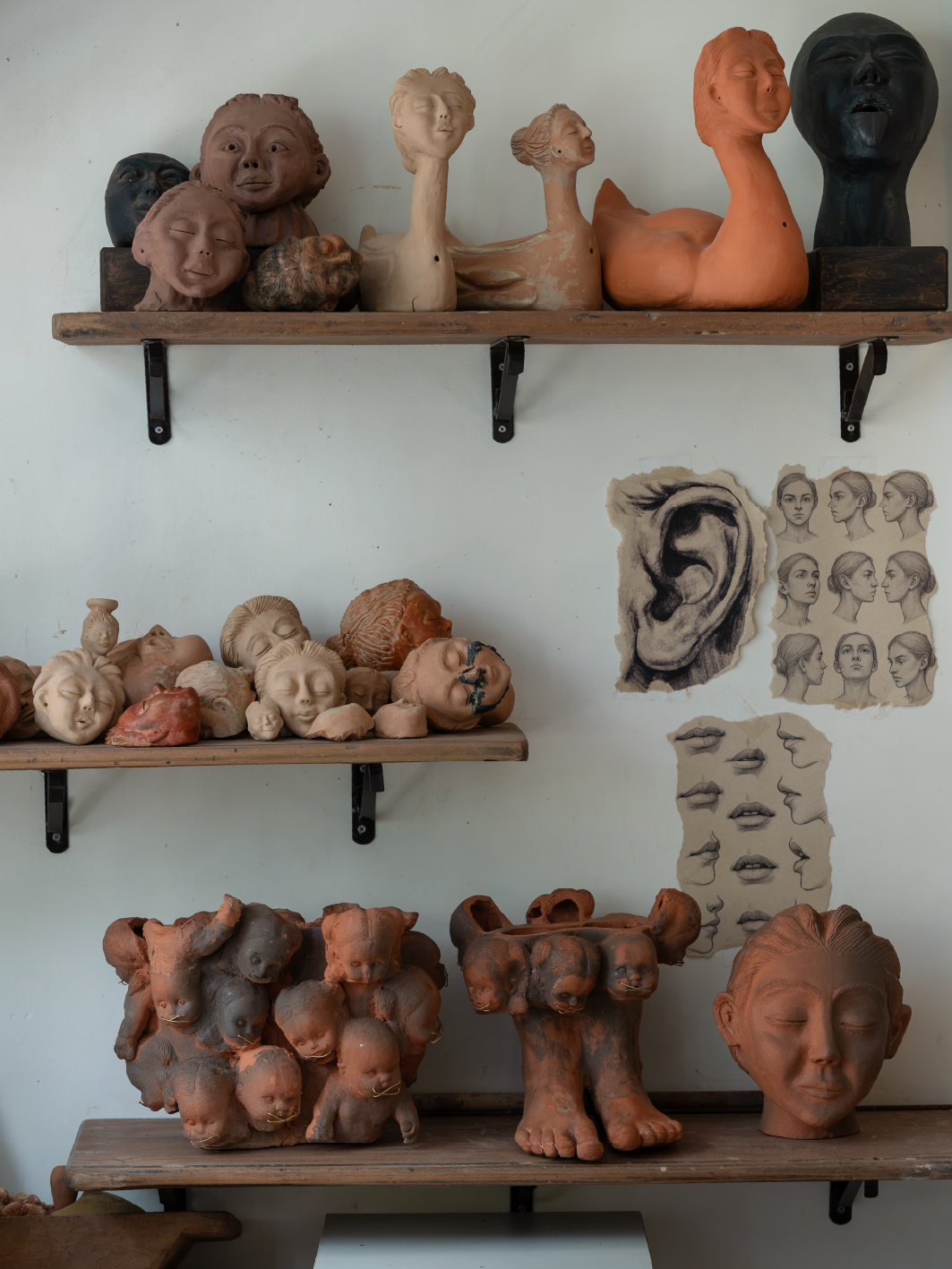
Jayati's home studio at her house in Juhu, Mumbai is filled with terracotta sculptures
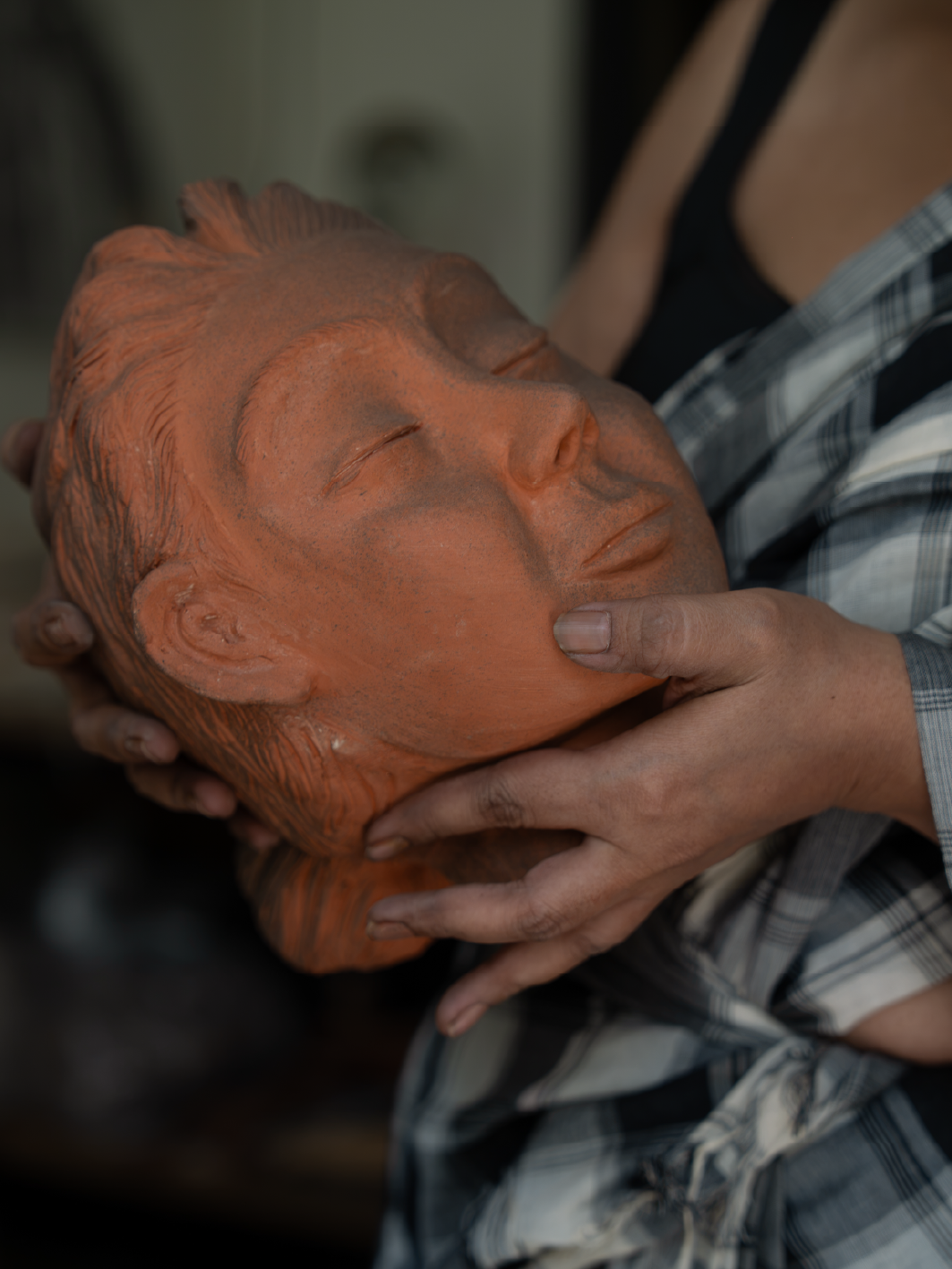
The artist creates a lot of sculptures that take the form of a human head as they allow her to pack psychological complexities within a restrained sculptural form
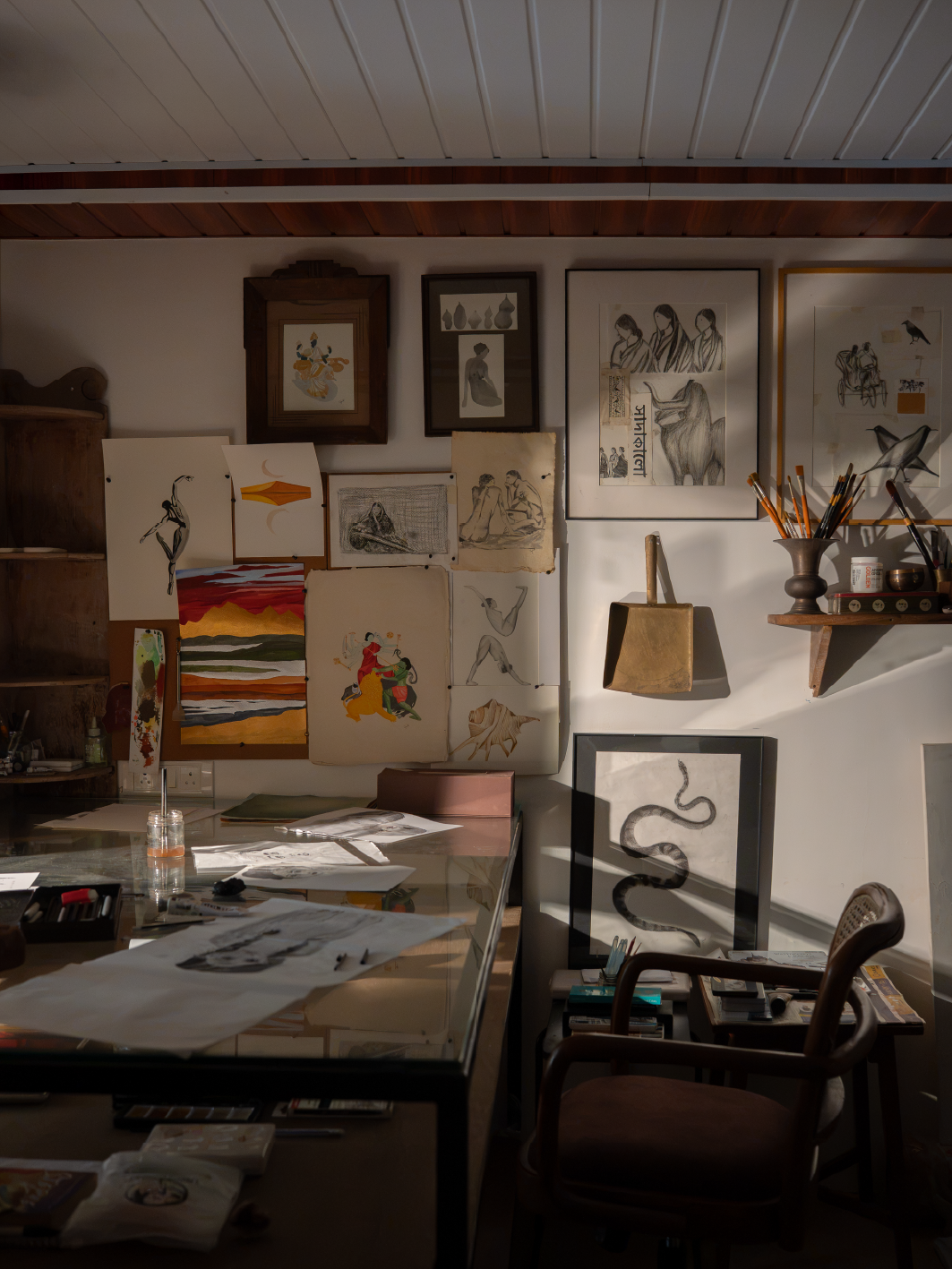
Her studio holds the many worlds that Jayati's imagination inhabits , watercolour paintings, charcoal sketches and clay sculptures
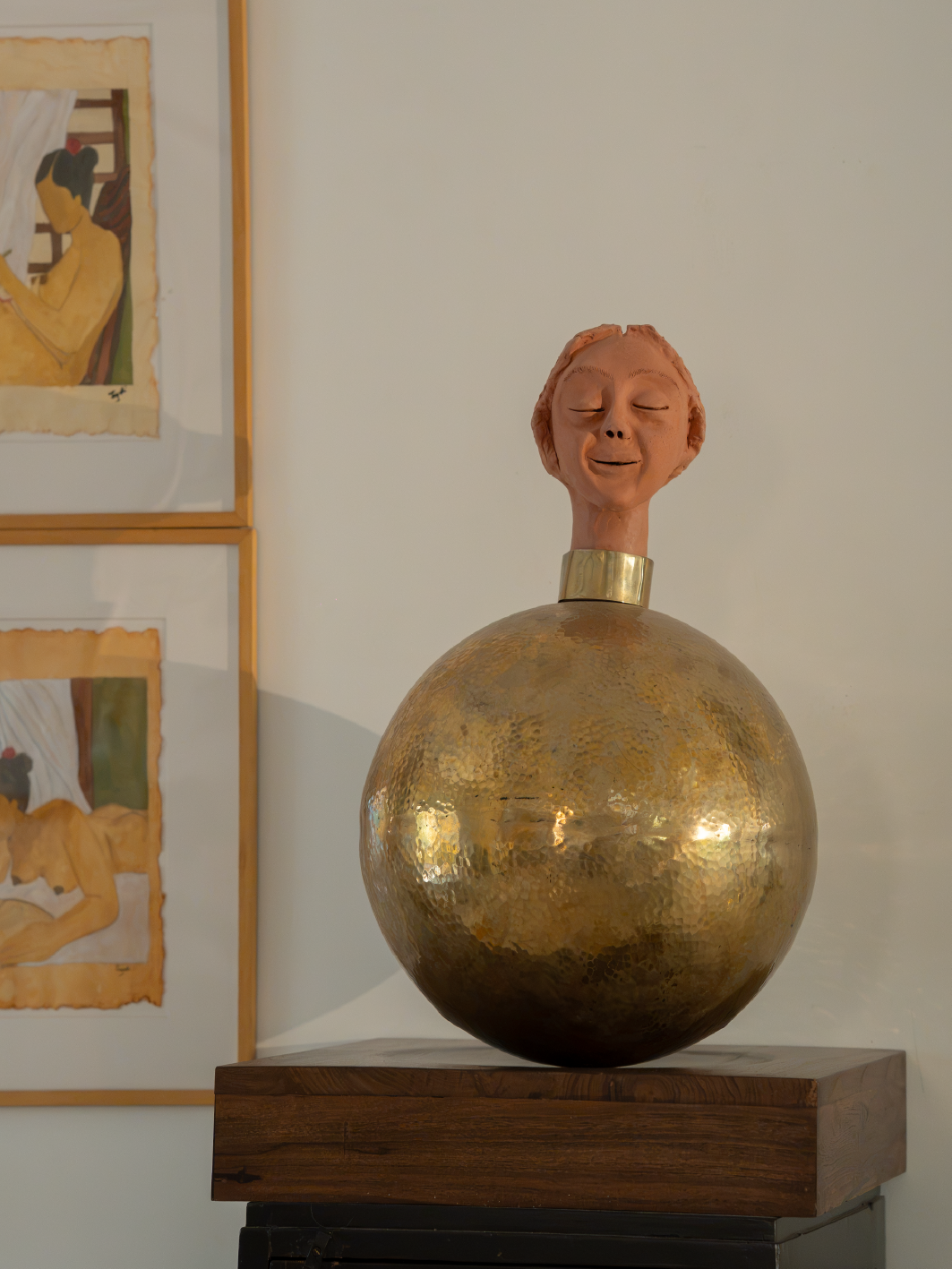
The forms of heads have their eyes shut and a smirk on their face that's meant to convey that the world doesn’t dictate anything for them and they know it
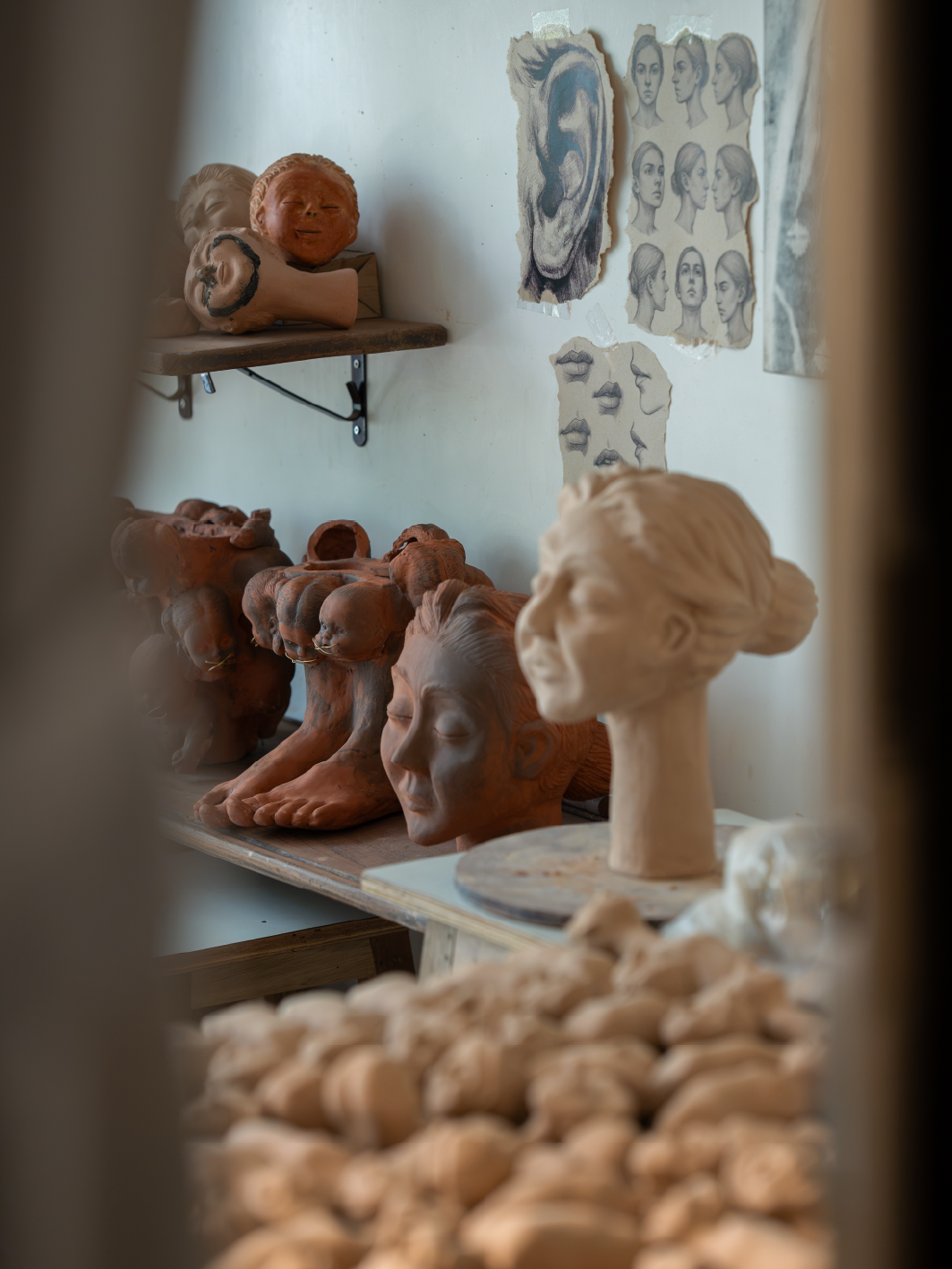
While most of art is either seen through the lens of expression or rebellion, Jayati says her work is more an act of quite refusal
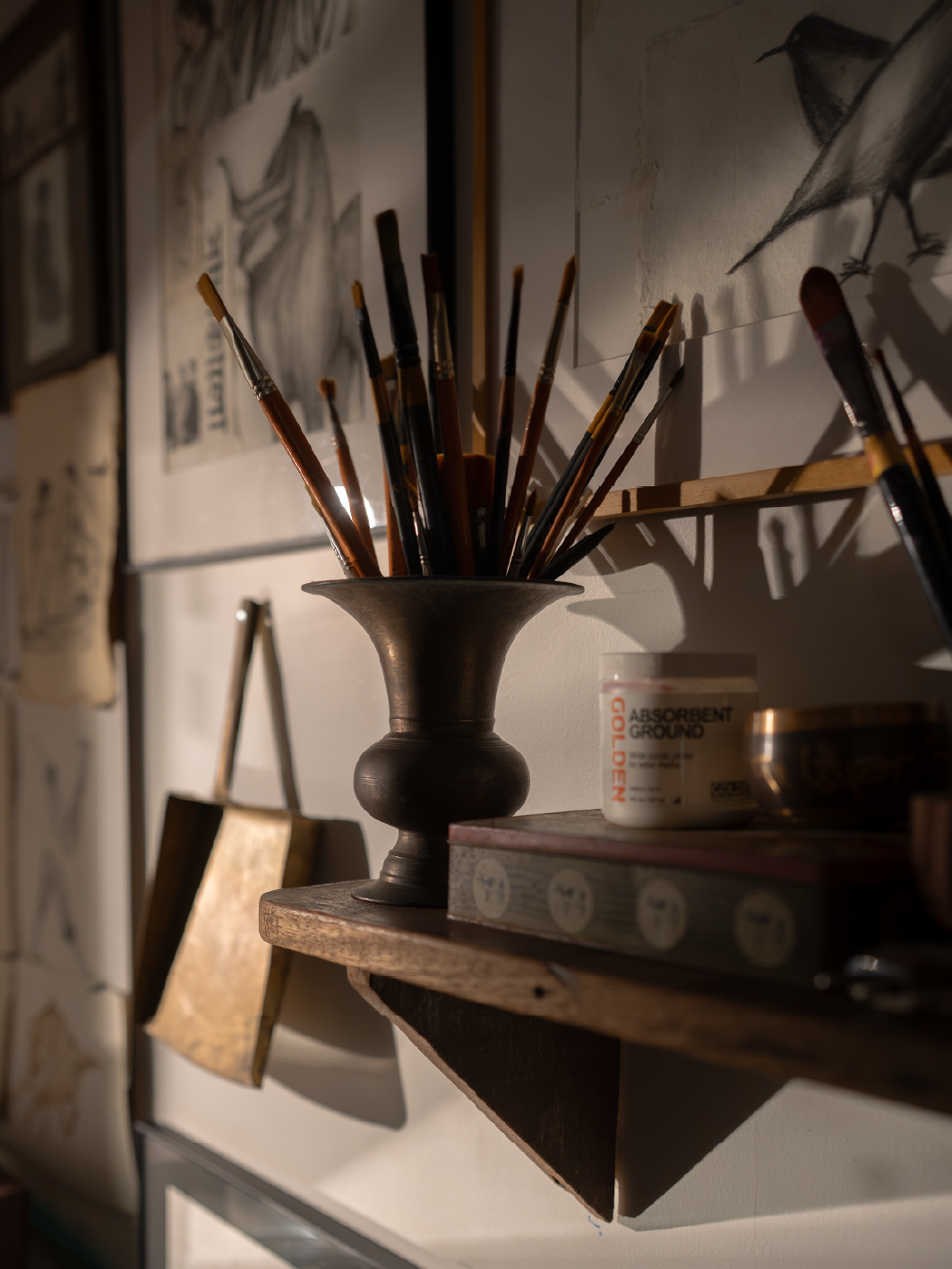
Her studio is a lived in space filled with the tools of the artist and the final product, you can almost trace the journey of her pieces as you walk through her studio
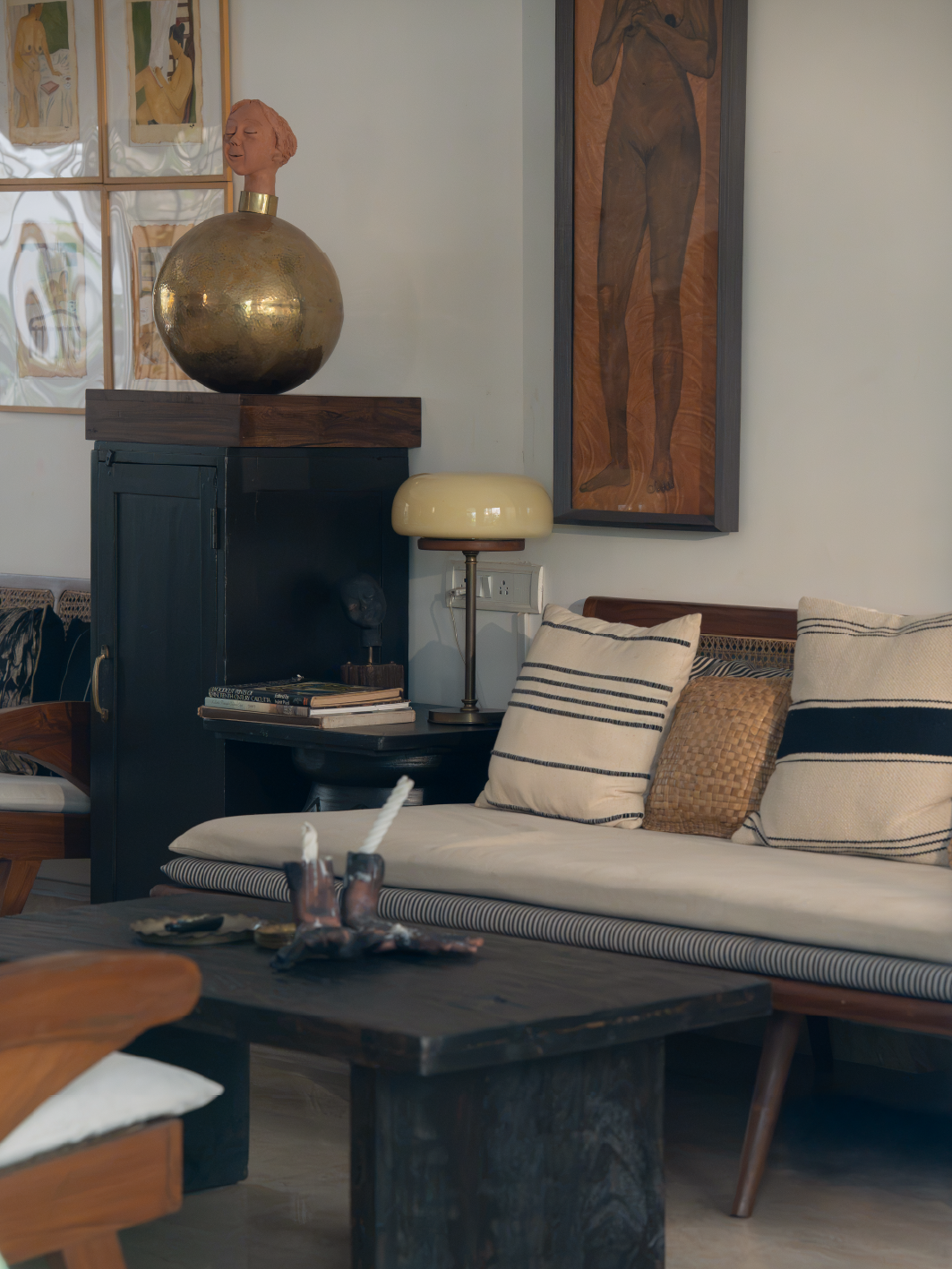
Jayati’s work often examines the relationship between individuals and the social, cultural and psychological forces around them often returning to memory, gender, autonomy, silence, childhood, domestic spaces, family and tradition
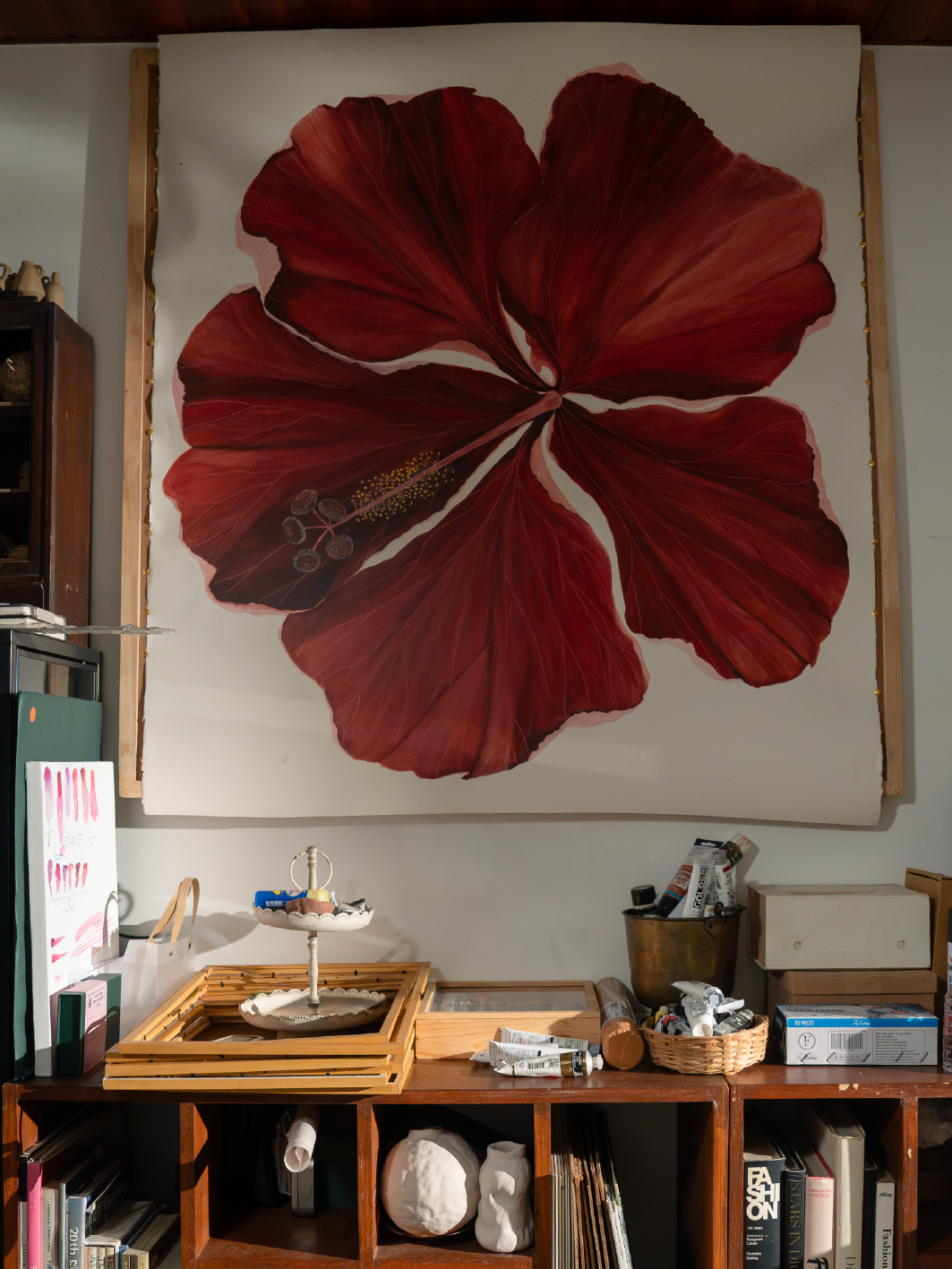
Hibiscus is the artist's favourite flower and her house is filled with sketches and paintings of different hibiscus flowers
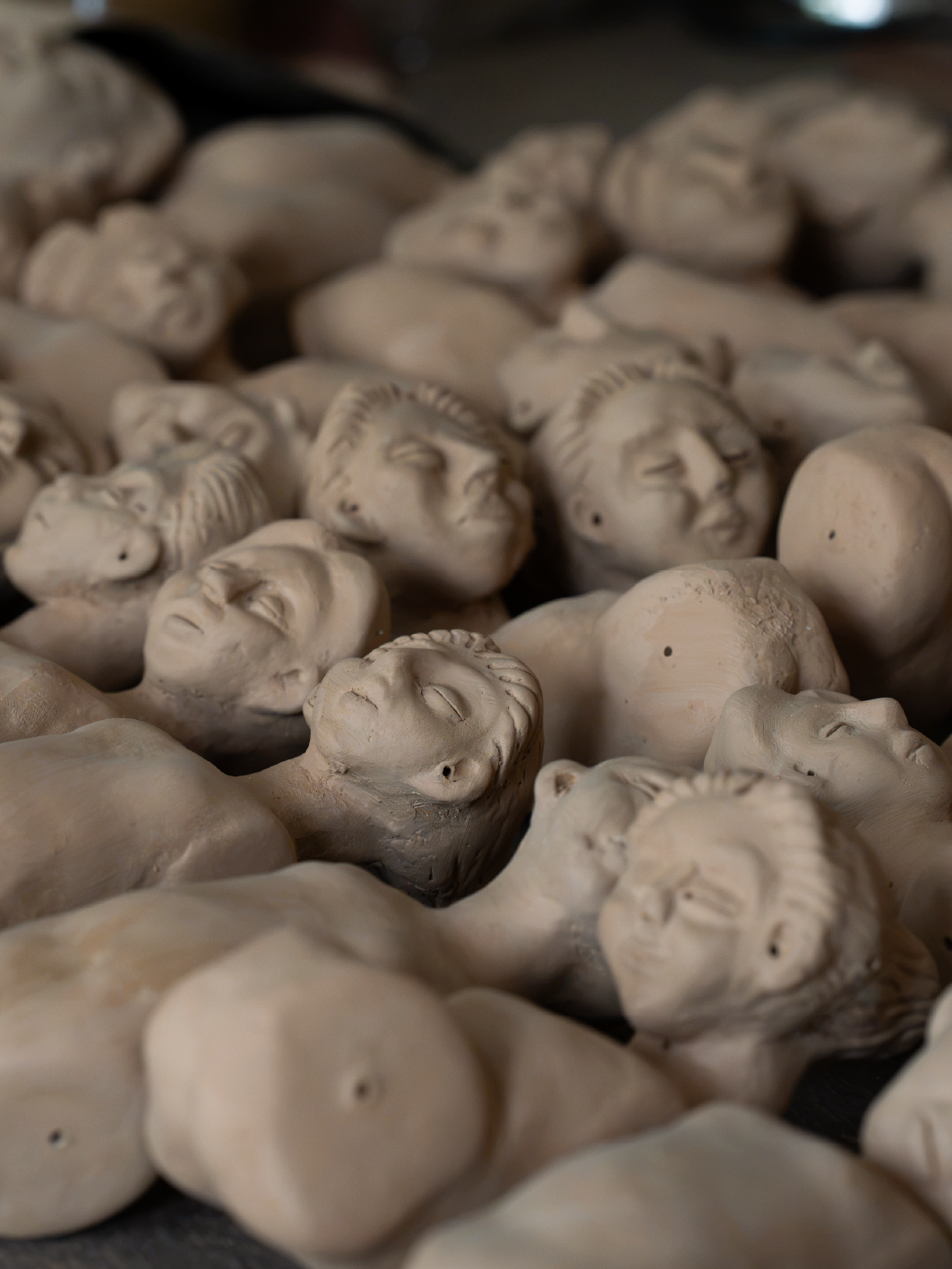
Clay is her favourite medium to work with because it allows her to shape an idea/ thoughts into a tangible form
These questions are also central to her practice.Her work centres around women and draws upon a lot of Bengali mythology and culture, which she admits has shaped her visual vocabulary. “I am particularly interested in our relationship with feminine power. We worship goddesses Durga as the destroyer of evil and Kali as a force that transcends fear and conventional ideas of femininity. Yet the everyday lives of women may still be shaped by deeply entrenched expectations of obedience, sacrifice and respectability. That distance between the symbolic power of women and their lived autonomy stays with me.” Jayati tries to address this disparity through her art. Case in point, her Women in Leisure series that she painted to depict women reclaiming their time, not bogged down by responsibilities and what society expects them to be but taking a break — enjoying a cup of tea together, playing a game of tug of war etc. In these series, the women are always in white sarees, faceless, a detail added on purpose so all women can relate to the painting. There are also always five women in the paintings in these series, depicting Jayati and her group of girlfriends, a tribute to their days of youth that were filled with leisure and unabashed joy. “I work extensively with drawings and compositional studies, paying attention to the relationships between figures and the negative space around them. Watercolour gives the images a lightness and restraint. The women are not shown confronting or rebelling against anyone. They behave as though they never needed permission in the first place.”
Of all the mediums of art form, Jayati’s favourite is working with clay and terracotta, “I love working with my hands and giving a tangible form to an idea,” she says. Clay, she says, is a material that retains every decision and hesitation. Growing up in West Bengal, clay wasn’t unfamiliar. It was present in terracotta, architecture, ritual, everyday objects and in the making of idols of gods and goddesses. “I remain fascinated by that movement between the sacred and the ordinary. The same earth can become a domestic vessel, a divine body or a deeply unsettling human figure. I also like that clay never completely obeys you. It responds to gravity, moisture, temperature and fire. It shrinks, moves and sometimes cracks. You can work with it, but you cannot exercise absolute control over it. Most of all, clay records touch. It allows something as fleeting as a human gesture to remain,” Jayati explains.
The process of creating usually begins with an idea or a thought that, in her own words, “refuses to leave her alone.” It might be an everyday gesture, a particular social behaviour, an object, a historical reference or an image. She then reads up on it and tries to understand its cultural, psychological and historical dimensions as well as its visual possibilities. Then come drawings, compositional studies and experiments with materials. “With sculpture, the choice of material is especially important. I ask myself why an idea needs to exist in terracotta, brass, wood or another material. What does the material already carry with it? What can its physical behaviour add to the work? The piece remains open to change throughout the making.”
Since Jayati primarily works with terracotta and earthenware clay, once the initial drawings are ready, shaping can take anywhere between several days to several weeks depending on the scale and complexity of the sculpture. For larger works, technical planning becomes especially important. The thickness of the clay, distribution of weight, internal construction and the way separate elements are joined, all affect how a piece behaves during drying and firing. Drying needs its own time too, taking several days and weeks depending on the dimensions, thickness and weather. Firing also varies with the clay body and the surface. She doesn’t have a kiln at the studio but has several friends who do pottery who live closeby and have kilns so she does the firing of all her pieces there without risking breakage of the delicate clay pieces.
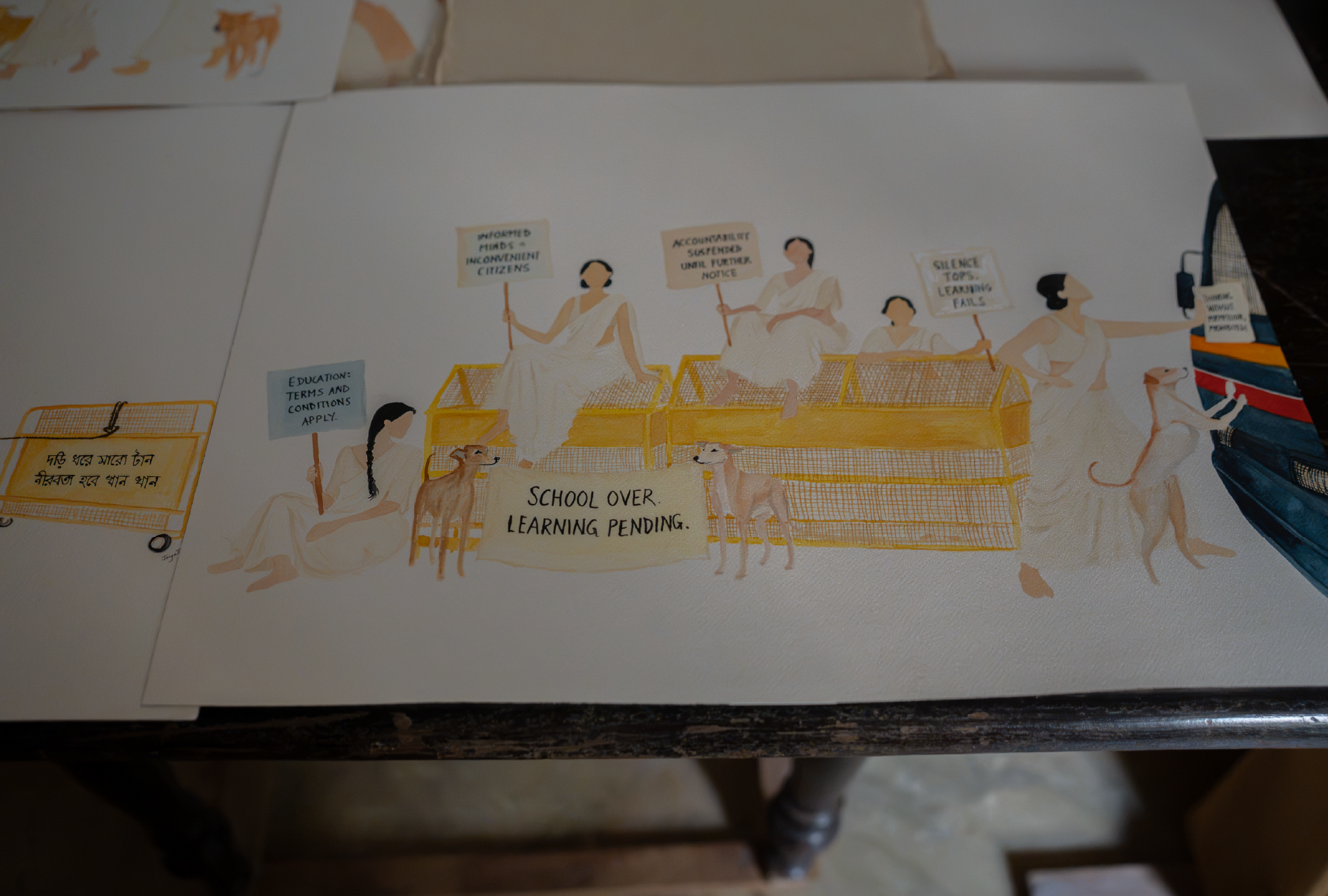
Women at the centre Her work centres around women and draws upon a lot of Bengali mythology and culture, which she admits has shaped her visual vocabulary
Jayati’s work often examines the relationship between individuals and the social, cultural and psychological forces around them often returning to memory, gender, autonomy, silence, childhood, domestic spaces, family and tradition. She creates a lot of sculptures that take the form of a human head as they allow her to pack psychological complexities within a restrained sculptural form. “All my forms of heads have their eyes shut and a smirk on their face. It’s meant to convey that the world doesn’t dictate anything for them and they know it, the smirk is supposed to be smug,” she explains, elaborating that there’s something powerful about a figure that does not reassure the viewer with eye contact.
Art is often seen through the lens of expression or rebellion. While Jayati’s work falls into the latter category, she prefers to call it quiet refusal, “Rejecting a prescribed role, questioning an inherited assumption or declining to accept something simply because it has always been accepted, my work is interested in these less conspicuous forms of resistance. My sculptural work can be more psychologically charged. It considers what happens when silence is imposed, when power operates within intimate relationships, and when structures expected to protect us become complicated.”
Be it terracotta sculptures, watercolour paintings or charcoal sketches, there’s no doubt that Jayati’s art is meant to evoke an emotional response in the viewer. It tethers between being relatable while also coming from a space of deeply specific experiences. “I don’t feel it is my responsibility to tell viewers what to think. I would rather create work that makes them pause, reconsider something familiar, or become less certain of an assumption they previously took for granted,” she concludes.