In London’s Kensington Gardens - where the annual pavilion by the Serpentine Galleries has, since its inception in 2000 with Zaha Hadid, come to occupy a singular position within the global architectural calendar - the 2026 commission arrives with a quieter, more grounded proposition. To mark its 25th edition, Mexico City-based architecture studio LANZA atelier turned away from overt formal gestures, drawing instead on a modest, almost pastoral architectural device: the crinkle-crankle wall.
The Intelligence of a Wall
Titled a serpentine, the undulating one-brick-thick wall typology—originating in Egypt and brought to England by Dutch engineers and since used across English gardens—is approached with restraint. LANZA atelier founders Isabel Abascal and Alessandro Arienzo neither replicate nor romanticise the storied form. Instead, they recast it as a spatial system which folds, encloses and opens in a continuous rhythm.
The pavilion unfolds as a series of gently curving brick walls beneath a light, translucent canopy, creating pockets of shade, passage, and pause that shift with the movement of the day. Its sinuous geometry lends the wall both structural strength and a softened presence, allowing it to move with the landscape rather than impose upon it.
There is a precise material intelligence at play here. Brick—so often associated with rustic, agrarian aesthetics and formal edges - is reworked into something lighter and atmospheric. Its thermal mass tempers the air, its irregular surface catches light in fragments, and its repetition establishes a cadence that is both tactile and spatial.
Walking through the structure, one imagines a gradual transition—from the dappled brightness of the park into moments of enclosure, where sound softens and the city recedes into a distant murmur. The canopy above, almost imperceptible in its lightness, filters daylight into a diffuse glow, allowing the pavilion to feel at once sheltered and open to the sky.

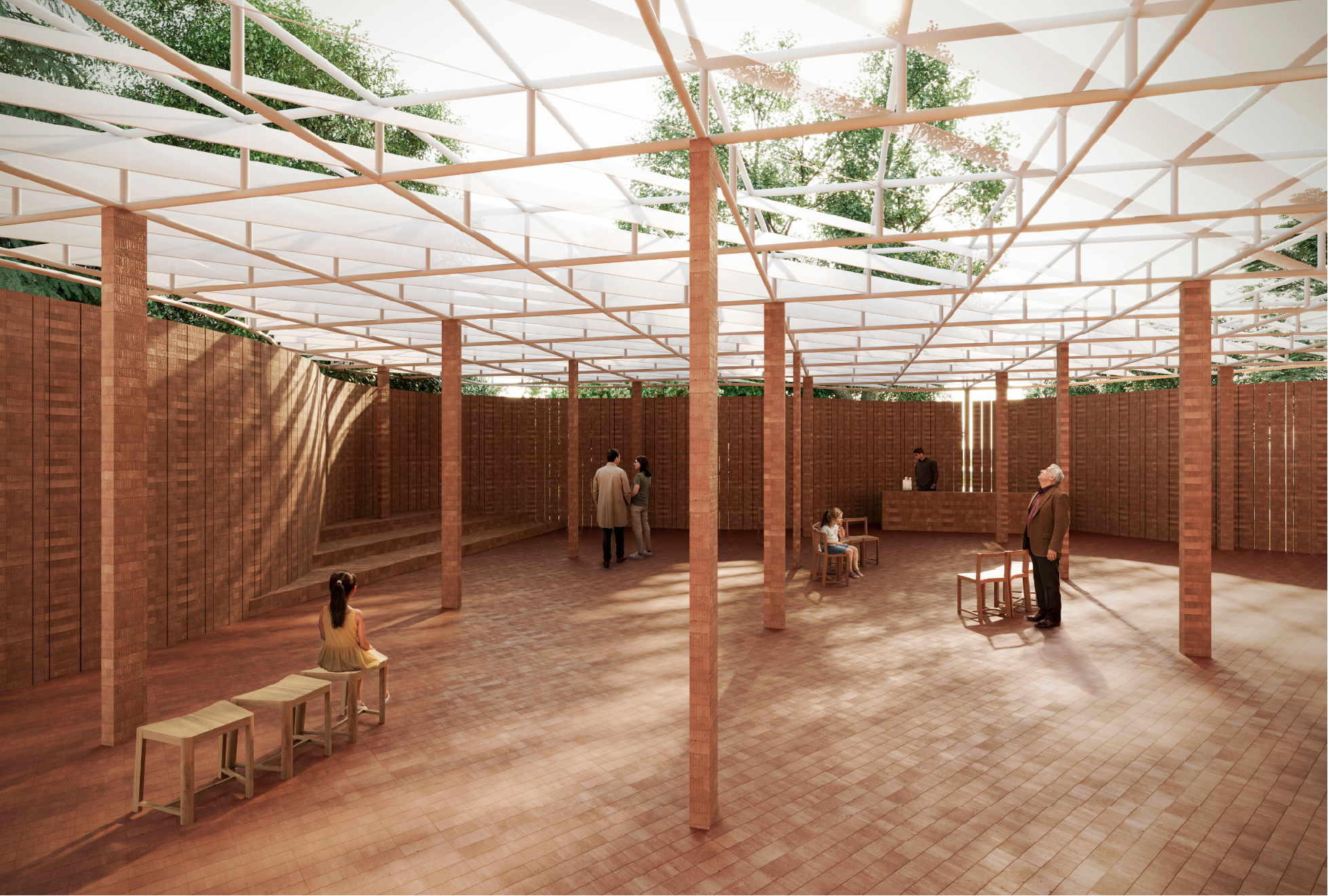
Interior render by LANZA atelier Christened ‘a serpentine’, the pavilion invites intuitive rather than prescriptive use
The Pavilion as a Platform
Conceived as a platform for architects yet to build in the UK, the Pavilion programme has, over the past two decades, evolved into a site of both experimentation and cultural signalling—where architecture is asked to perform, provoke, and, at times, simply gather. Within the Serpentine’s recent history, pavilions by practices such as Bjarke Ingels (Copenhagen) or Sumayya Vally (South Africa) have explored sculptural singularity and symbolic narratives.
A serpentine, in contrast, reads as a quieter counterpoint. Its emphasis shifts from image to occupation, less object and more environment.The wall meanders without prescribing use, inviting a slower, more intentional and intuitive inhabitation. In doing so, the project aligns with a broader architectural discourse that seeks to re-centre craft, locality, and environmental responsiveness—not as aesthetic gestures, but as fundamental design principles.
Within the pavilion’s inherently temporary framework, questions of permanence persist. These structures, though seasonal, often carry the weight of memory and place. LANZA atelier’s pavilion, with its rooted materiality and historical references, feels particularly attuned to this tension. It does not stand apart as an object. Its strength lies in its capacity to belong—to the lineage of garden architecture, to the craft of brickmaking, and to the evolving narrative of the pavilion itself.
A serpentine by LANZA atelier will be on view at Kensington Gardens from June 6 to October 25, 2026.