Restaurants 10 Aug 2026 read
This Cliffside Café is built inside a 100-million-year-old mountain
The coffee and the architecture at The Cliffside Café are both a lesson in measured extraction complete with a dramatic rockface and an UNESCO tag.
Restaurants 10 Aug 2026 read
The coffee and the architecture at The Cliffside Café are both a lesson in measured extraction complete with a dramatic rockface and an UNESCO tag.
There’s sipping on your morning espresso at home while watching the familiar choreography of city life unfold below, and then there’s ordering your favourite cup 600 metres above sea level, enveloped by the mountain-side surrounded by the raw texture of ancient volcanic rock. At Cliffside Café in China’s Zhejiang Province, visitors can do exactly that. In order to revitalise and renew the Yandangshan scenic areas in the Zhejiang Province and attract a younger consumer cohort, the Yandangshan Scenic Area Management Committee commissioned a project to turn naturally occurring caves along volcanic cliffs into immersive public spaces.
Built inside the Yandang Mountain, the Cliffside café is categorised as a national 5A level scenic spot and UNESCO Global Geopark. But how do you design a café that fits inside the crevice of a mountain that is at least 100 million years old? Xu Jinglei, Design Director of Slow Coral Design who designed the space says, “The site's unique mountainous terrain became the starting point of the design. Rather than creating an independent architectural object, the project aimed to minimise intervention and allow the building to naturally integrate into the surrounding landscape.”

Instead of altering the site, the café was built to follow the natural contours of the mountain. In projects like these, besides exercising aesthetic restraint, one needs to also focus on materials that can weather the storms, quite literally. Material selection was therefore guided by three important factors —adaptability to the environment, durability, and reduced maintenance requirements. Additionally, it was important to pick materials that could sustain the challenges like high humidity, heavy rainfall and temperature fluctuation. Hence, lightweight steel structures and timber were the natural choices. “The application of the lightweight steel structure responds to the challenges of mountain construction. By reducing on-site wet work and minimising structural weight, it decreases disturbance to the existing terrain while improving construction efficiency,” explains Jinglei. Beyond convenience, these architectural techniques and materials also help the structure integrate seamlessly in the mountain rather than standing out as a visual landmark.


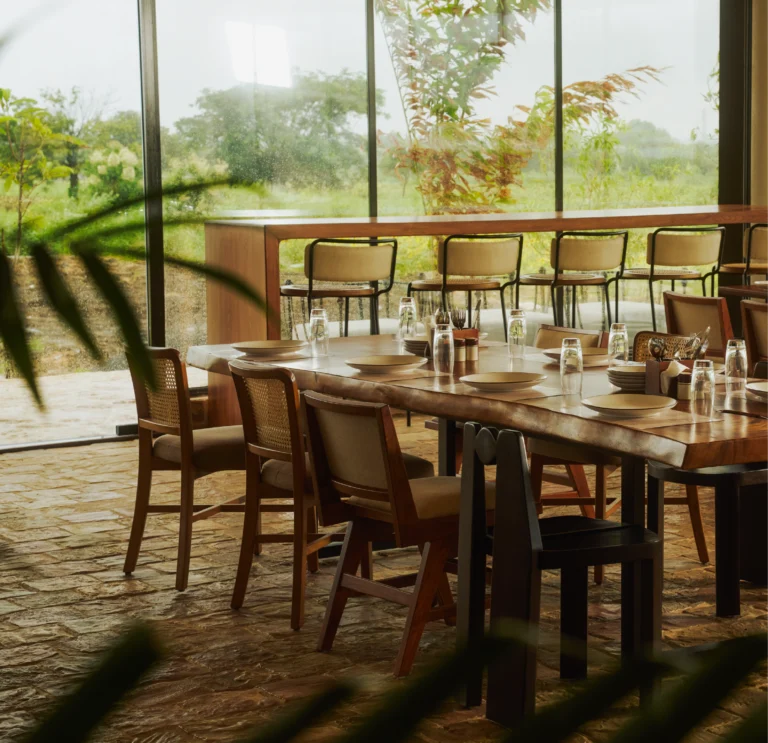
The rugged dramatic effect of the mountains is offset by the warm interiors and open layout of the café. Open decks allow the visitors to experience different views of mountains and valleys from different locations, enclosed glass viewing rooms are inserted into rocks, timber floors and rattan chairs that not only match the colour palette of the mountain but also add warmth to the space. Lighting in the space changes through the day. While in the morning, the sun illuminates the rocks, as evening falls, concealed lighting and LED strips afford the place a dramatic effect with only the café glowing as the mountains sink into darkness.
For the designers, the interiors were never intended to compete with the scenery. Instead, they were conceived as an extension of it. “Visitors are not only viewing nature but also staying within and experiencing it,” says Jinglei. “The architecture acts as a medium connecting people with the mountain environment, strengthening the relationship between visitors and the site.”
Without compromising on the aesthetics, the Cliffside Café project ensured that the natural terrain and ecosystem was not disturbed by minimising site alteration and adapting the building to the existing terrain instead of the other way round. Natural ventilation, maximum utilisation of daylight and usage of durable materials ensured that over time the building could adopt better to the mountainous terrain. “The project is not designed as a temporary tourism attraction, but as a long-term space that can coexist and grow together with the mountainous landscape,” explains Jinglei.
The Cliffside Café invites visitors to settle into a natural landscape, take a break from their algorithm and sip a cup of freshly brewed coffee as the gentle breeze drifts through the space and the landscape unfolds around them, one contour at a time.